A2 Media Studies Advanced Portfolio
Ester Dios Vidal
Click ALL the titles in the menu bar.
INTERTEXTUALITY
What is intertextuality?
Intertextuality in media refers to when one media text refers to another media text. There are multiple ways in which texts can be intertextually related. Strinati described hybridity, parody and pastiche.
Intertextuality can be found in a wide range of media forms, including literature, film, television, music, and advertising. It is often used as a way of creating meaning or building connections between different media pieces, and can be used to arouse certain emotions or cultural associations in the audience such as nostalgia. For example, a television seire may contain iconic music, a television show may contain references to famous movies, or maybe even a music video may contain elements of a classic novel.
Intertextuality can be used to create a sense of familiarity or recognition for audiences who are familiar with the referenced text, as well as to add depth or complexity to a work by establishing connections between different texts. It can also be used to create new meanings or interpretations, as well as to challenge or subvert established meanings.
Examples of intertextuality in media include the use of pop culture references in movies and TV shows, the borrowing of themes and motifs from classic literature in contemporary novels, and the remixing of elements from different music genres in modern pop songs. By drawing on existing texts and media pieces, intertextuality allows creators to build on established cultural traditions and create new meanings and interpretations for their audiences.
Overall, intertextuality is an important aspect of media literacy and understanding how media texts relate to each other can help us to better understand the ways in which media influences our understanding of the world.
PARODY
PASTICHE
A parody is a work that mimics the style of another work, artist, or genre in an exaggerated way, usually for comic effect. Parodies can take many forms, including fiction, poetry, film, visual art, and more. For instance, Scary Movie and its many sequels are films that parody the conventions of the horror film genre.
Pastiche is an artistic work in a style that imitates that of another work, artist, or period. This will intentionally use the style of something else, but not for humour.
HOMAGE
Homage is where one author or artist shows respect to another by allusion or imitation. This is a deliberate recognition of another media text to show respect for it.
Direct intertextuality vs Indirect intertextuality
Direct intertextuality refers to a clear and specific reference to another text within a work. These can be quotes, allusions, or references to specific people, events, or themes from another text. Examples of direct intertextuality are poems that contain direct quotes from famous novels and movies that explicitly reference popular television shows.
On the other hand, indirect intertextuality refers to a more subtle or general influence of one text on another. It refers to the media more generally. This can include similarities in themes, styles, or structures between two texts that may not have an explicit or intentional connection. A specific example of indirect intertextuality would be a novel that explores themes of identity and belonging in a way that is similar to another novel.
In conclusion, direct intertextuality involves explicit references to specific elements from another text, whereas indirect intertextuality involves more subtle connections and influences between texts.
Examples of intertextuality
Ariana Grande - thank u, next (Official Video).
Ariana Grande’s “thank u, next” music video is one of the most clear and famous examples of intertextuality in media. The video very clearly references four iconic 2000s movies; Mean Girls, Bring It On, 13 Going on 30, and Legally Blonde in turn.
You can see this from the very beginning as the video starts off with people being interviewed discussing rumours about Ariana Grande, including pregnancy and her alleged relationship with a girl named Aubrey. This was inspired by the beginning of Mean Girls, introducing the one and only Regina George. Like this one, there are many examples more of intertextuality such as:
Aaron Samuels

The Burn Book

The original actor from the movie 'Mean girls' replays his role as Aaron Samuels in the music video, repeating a very famous phrase of his as he is personally told by Ariana how his hair "looks sexy pushed back".
This is a very clear example of intertextual reference to 'Mean Girls'. It recreates one of the most famous parts of the movie as Regina also has a burn book.
"Jingle Bell Rock"

vs
Parody

Original
The music video also references Bring It On, a 2000 cheerleading comedy film, as Ariana Grande interprets its famous dance-off scene .
Grande also alludes to her recent breakup with SNL comedian Pete Davidson through referencing 13 Going on 30. The tells the story of Jenna Rink, a magazine editor who fell in love with her best friend but didn’t end up marrying him, very similar to Ariana Grande’s situation. With 13 Going on 30 Ariana shows her more vulnerable side.
Legally Blonde is the last reference in the music video. Ariana Grande plays the iconic Elle Woods herself, with a special appearance from Jennifer Coolidge to exactly recreate the “bend and snap” scene from the movie. She makes all these references but with her own sense and style.
A common critique of this postmodern quality, is that it allows media products to gain from the good feelings or nostalgia attributed to the referenced media, without contributing something new.
However, Ariana has managed to make lots of references to other text whilst at the same time she adds her one twists to avoid this.


Madonna - Vogue
Madonna's music video has very evidently intertextual references to the fashion magazine 'Vogue' and the famouse Hollywood star Marylin Monroe. This can be immediately seen simply through the name of the song.

Reflects the Hollywood achetype of the attractive blond girl who simply uses her looks to get what she wants.

Example of pastiche in Madonna's music video. Madonna can be seen wearing a very similar white dress with a low neck as well as having perfect skin, blonde hair and bright lips as the one and only Marylin Monroe.
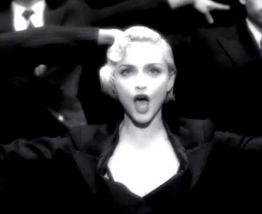
There is another intertextual reference to the 'Art Deco' age in the 20s and 30s as the music video has been intentionally editied to look like a 1930’s black and white Hollywood film deco art movement to enhance these concepts. The video being in black and white adds a photographic and film look
Why is intertextuality used and how might it appeal to an audience?
Intertextuality is used in media for a wide range of reasons. One of the main reasons is to create deeper connections and meanings within a piece of media. By referencing or alluding to other texts, such as books, films, or songs, media creators can add layers of meaning and context that may not have been apparent otherwise. Intertextuality can also be used to pay homage to or parody other works, as well as to establish a sense of cultural literacy or shared knowledge among audiences. Additionally, intertextuality can be used as a marketing strategy, as references to popular media can attract fans of those works to a new piece of media. Overall, intertextuality is a powerful tool that media creators can use to enhance their work and connect with their audience in meaningful ways.
Due to the intertextual reference in differnet media forms, audiences may be attracted to consume it. Intertextuality is often found in the form of pop culture references intended for the audience to recognise and gain satisfaction from. Because of this, many would argue that we are in a time were everything can now be considered copies of copies, as observed by the theorist Jean Baudrillard.
My inspiration
Before creating my music video, I did a lot of research to inspire myself and decide exactly how I wanted everything to look like.
Photos taken from


Inspiration:


I was also inspired by this music video. I really liked the narrative told as well as the location. In my music video I also show the life of two teenagers which suffer from a break-up. Furthermore, I decided to film in a place where there was not many people. I purposely did this so the audience would not get distracted and therefore emphatize with the characters more easily.